
Service · Atlanta, GA
Pine Straw Installation in Atlanta
Long-leaf pine straw laid by hand, not raked from a bag and left in clumps. The right call for azalea and camellia beds, sloped lots, and anyone who wants the lowest cost per bed in metro Atlanta.
Pine straw installation across metro Atlanta
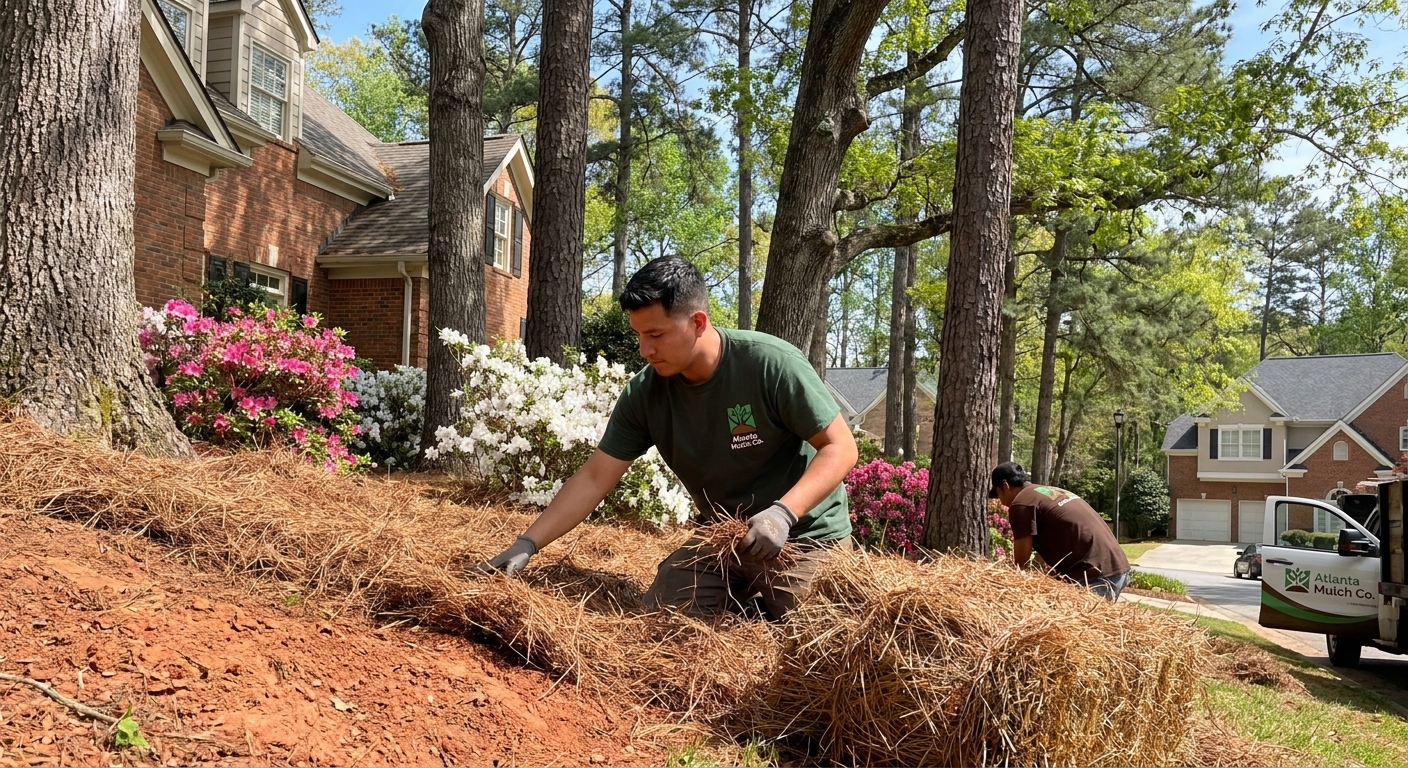
Pine straw is long-leaf pine needles baled at the farm and laid in interlocking mats rather than spread and raked like bark or hardwood mulch. That interlocking structure is exactly why it holds a slope better than loose bark — the needles physically knit together instead of tumbling downhill in a heavy Atlanta thunderstorm, which makes it the material of choice for the hillside beds common across north-metro communities like Roswell and Alpharetta.
Why azaleas and camellias do best under pine straw
Older Atlanta neighborhoods are full of mature azaleas and camellias, both of which prefer slightly acidic soil. Pine straw breaks down slowly into a mildly acidic organic layer that suits these plants better than hardwood or bark mulch, which trend closer to neutral as they decompose. If your beds are built around established azaleas, pine straw is very often the right call before we even discuss cost.
How pine straw is priced and installed
Unlike bulk mulch, pine straw is priced and sold by the bale, not the cubic yard. One bale covers roughly 35 to 45 square feet at a proper 3-inch loose depth, depending on how tightly it was baled at the farm. It is laid by hand, fluffed and tucked around plant bases rather than dumped and spread with a rake, which is part of why labor cost per bale runs a bit higher relative to material cost than bulk mulch does.
| Job | Typical range | What moves the price |
|---|---|---|
| Pine straw, installed | $8 – $12/bale | Bale count, bed slope and access |
| Pine straw, delivery only | $5 – $7/bale | Bale count and drop location |
| Old pine straw removal | $2 – $4/bale-equivalent | Volume and compaction |
| Typical foundation bed (200–300 sq ft) | $50 – $90 installed | 5 to 8 bales at proper depth |
Pine straw vs. bark and hardwood
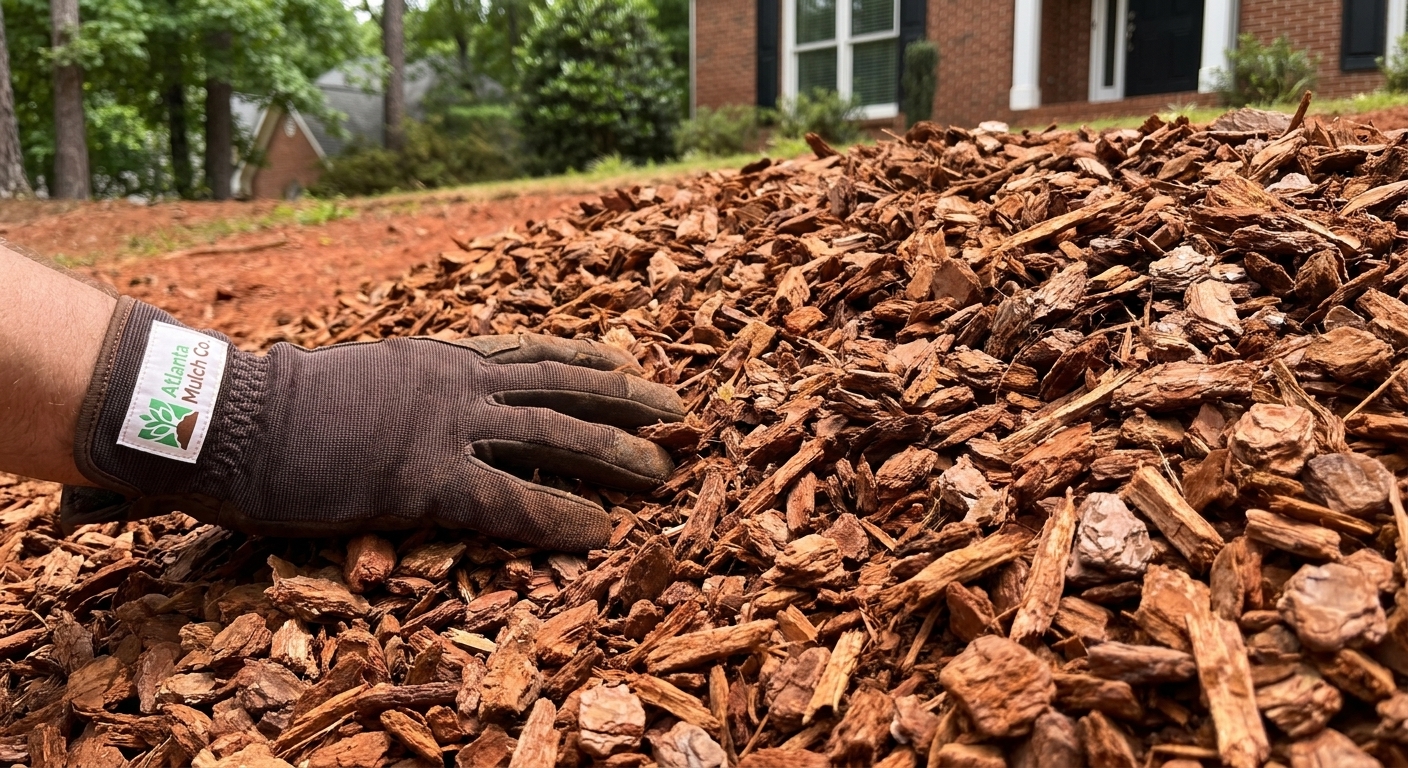
Pine straw is the lightest material to move, which lowers labor cost on large areas, and it is the best option for slopes where bark tends to migrate downhill after heavy rain. What you trade for that is faster fading — typically 2 to 3 months of rich color versus 10 to 14 months for bark or hardwood — and it does not suppress weeds quite as completely as a properly depth-checked bark bed, since loose needle mats have more gaps than packed wood chips. For a full side-by-side, see our mulch comparison on the homepage.
Where pine straw makes the most sense
- Azalea, camellia and rhododendron beds where soil acidity matters.
- Sloped lots and hillside beds where bark washes downhill in heavy rain.
- Large properties where lower per-bale labor cost matters more than long color life.
- Beds where a natural, less "landscaped" look is preferred over uniform dyed mulch.
Where we install pine straw
We install pine straw throughout metro Atlanta, including Roswell, Alpharetta, Johns Creek, Dunwoody, Decatur and Marietta. If your beds need clearing or an edge repair first, see landscape bed edging and prep.
Questions
Pine Straw Installation FAQs
$8 to $12 per bale installed, depending on bale count, bed slope and access. A typical 200 to 300 square foot foundation bed needs 5 to 8 bales and runs $50 to $90 for the full install.
Roughly 35 to 45 square feet at a proper 3-inch loose depth, though coverage varies a bit by how tightly the straw was baled at the farm. We calculate exact bale count during the estimate based on your measured bed area.
It is a lighter, more exposed material that breaks down and bleaches in sun faster than dense wood chips. Expect rich color for 2 to 3 months versus 10 to 14 months for bark or hardwood mulch, though pine straw still functions for weed suppression and moisture retention well past that point.
Yes, it is generally the best mulch choice for these plants. Pine straw breaks down into a mildly acidic organic layer that suits acid-loving plants better than hardwood or bark mulch, which are closer to pH-neutral as they decompose.
Yes, noticeably. The long needles interlock into a mat that resists sliding downhill in heavy rain far better than loose bark chips, which is why it is the standard choice for hillside beds across north Atlanta suburbs like Roswell and Alpharetta.
Dry pine straw is more combustible than wood mulch, which is a consideration directly against a home’s wood siding in wildfire-prone regions. In metro Atlanta this is a minor practical concern rather than a regulatory one, but we are happy to discuss defensible-space spacing if it matters for your property.
Every 2 to 3 months if you want consistently rich color. Many homeowners stretch that to twice a year and simply accept a faded, silvery-brown look between refreshes, which is a perfectly reasonable tradeoff since it still functions for weed and moisture control.
Yes, and it is common — pine straw on sloped or azalea beds, bark or dyed mulch on flat front-entrance beds where longer color life matters more. We will tell you which material fits which bed during the estimate rather than defaulting to one material property-wide.
Yes, delivery-only pine straw runs $5 to $7 per bale if you want to lay it yourself. Because it is laid by hand rather than spread with equipment, DIY installation is more approachable for pine straw than for bulk mulch.
Related
Other mulch work we do
Get a pine straw estimate
Free on-site measurement and bale count. Flat written price before we start.
Mon–Sat 7:00am–7:00pm · Licensed & insured · Serving Atlanta and metro Atlanta